My research explores how robots can intelligently interact with complex environments, focusing on active visual perception, object rearrangement planning, and object manipulation in cluttered environments. I develop learning- and planning-based methods that allow robots to reason about their surroundings and perform multi-step manipulation tasks efficiently.
Embodied IntelligenceRobot Active Visual PerceptionTask & Motion PlanningMulti-Agent Systems
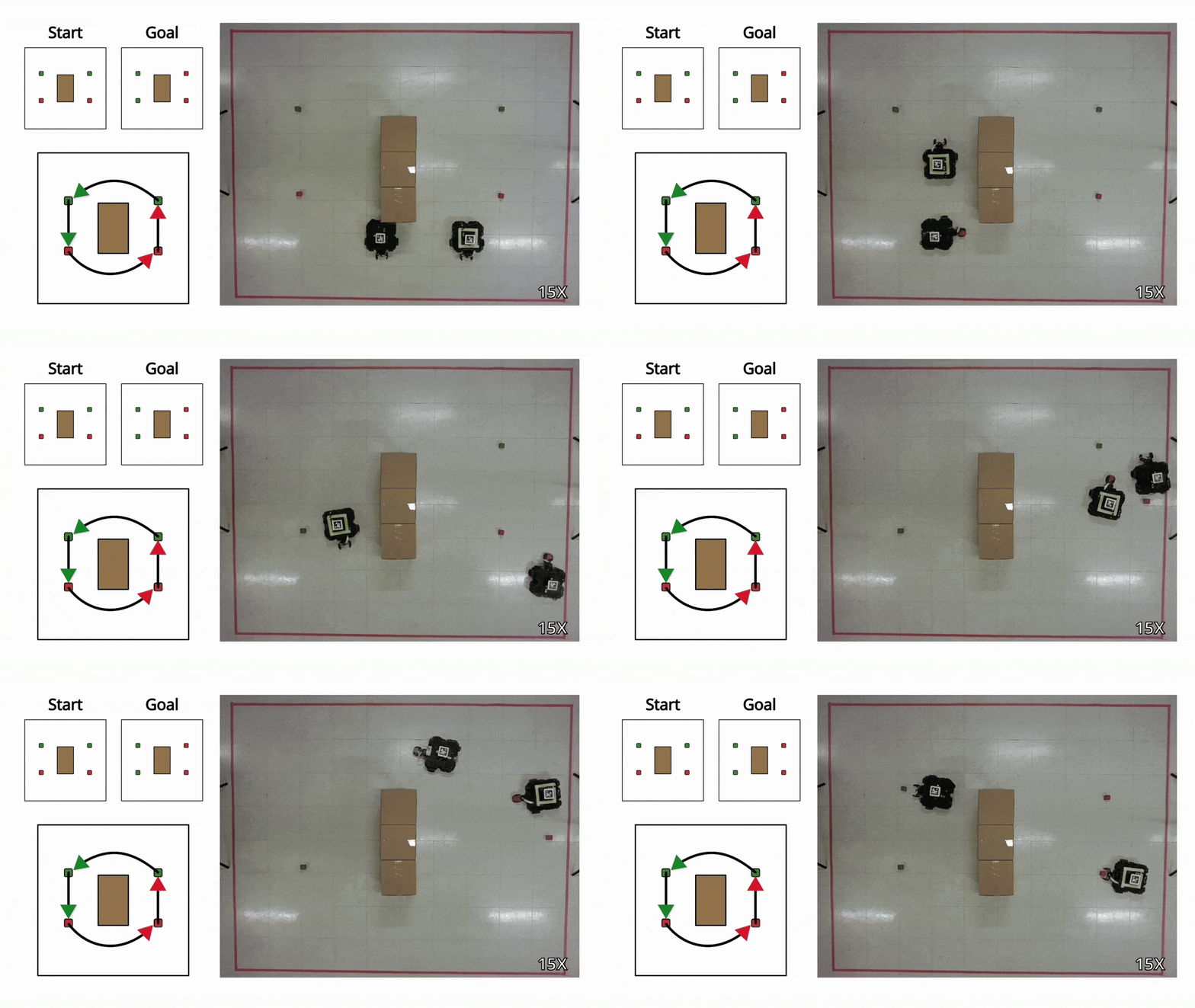
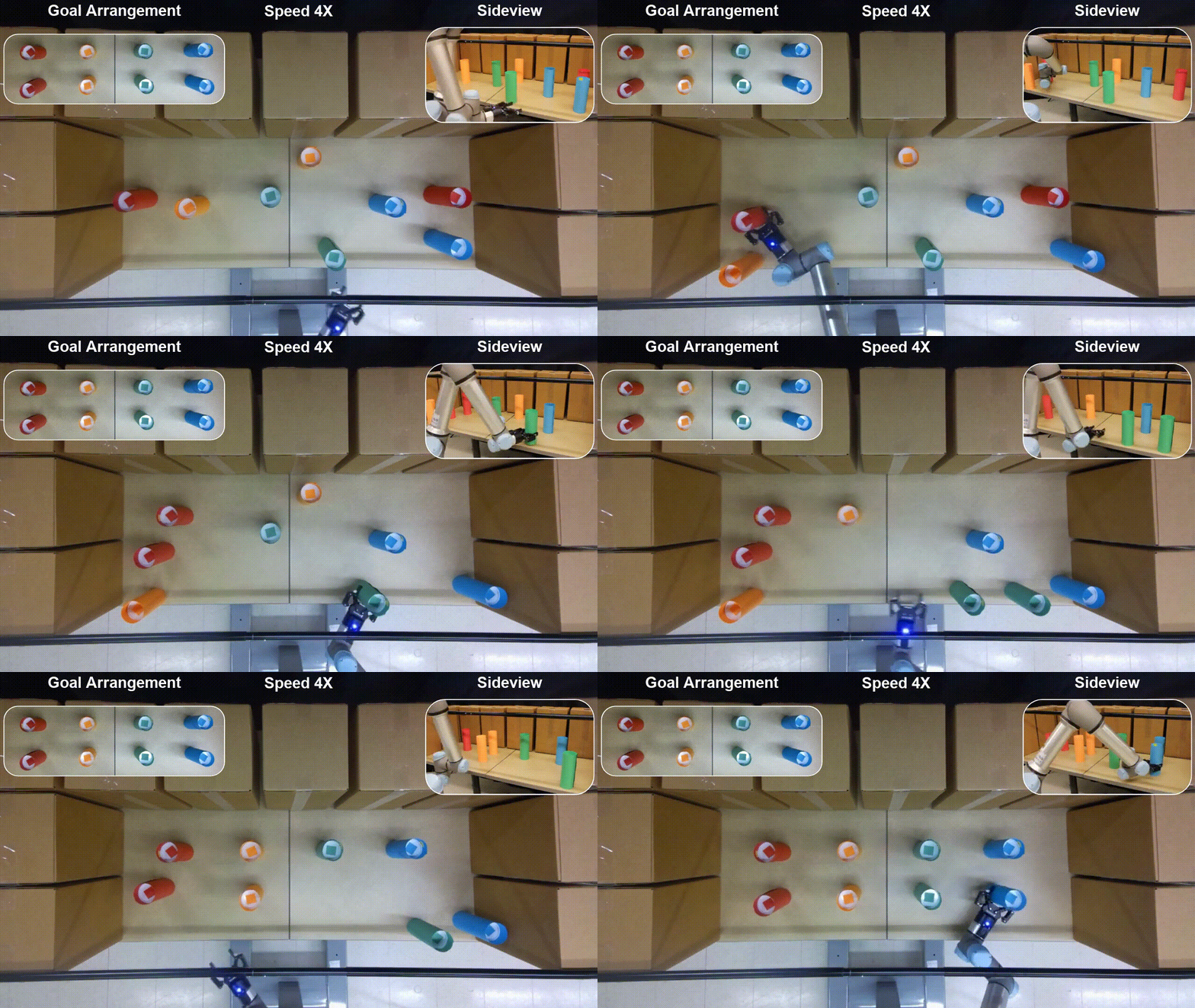
Multi-Agent Monte Carlo Tree Search for Makespan-Efficient Object Rearrangement in Cluttered Spaces
Hanwen Ren, Junyoung Kim, Aathman Tharmasanthiran and Ahmed H. Qureshi
ICRA 2026
We introduce CAM-MCTS (Centralized Asynchronous Multi-Agent Monte Carlo Tree Search), a planning framework for collaborative object rearrangement in cluttered environments. CAM-MCTS enables multiple robots to coordinate manipulation actions while optimizing the overall task makespan. The method combines centralized planning with asynchronous execution so agents can begin new actions without waiting for global synchronization, reducing idle time and improving efficiency.
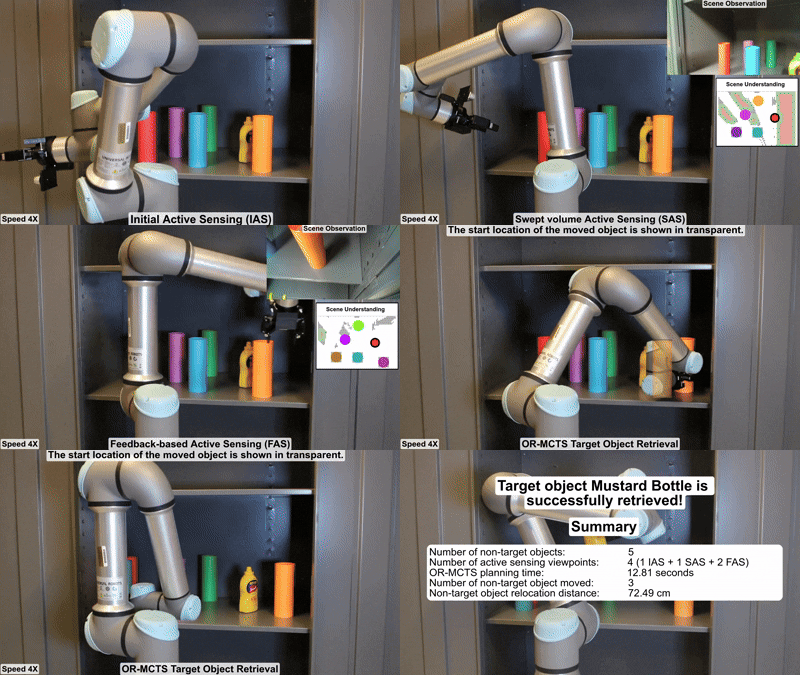
Integrating Active Sensing and Rearrangement Planning for Efficient Object Retrieval from Unknown, Confined, Cluttered Environments
Junyoung Kim*, Hanwen Ren*, Ahmed H. Qureshi
ICRA 2025
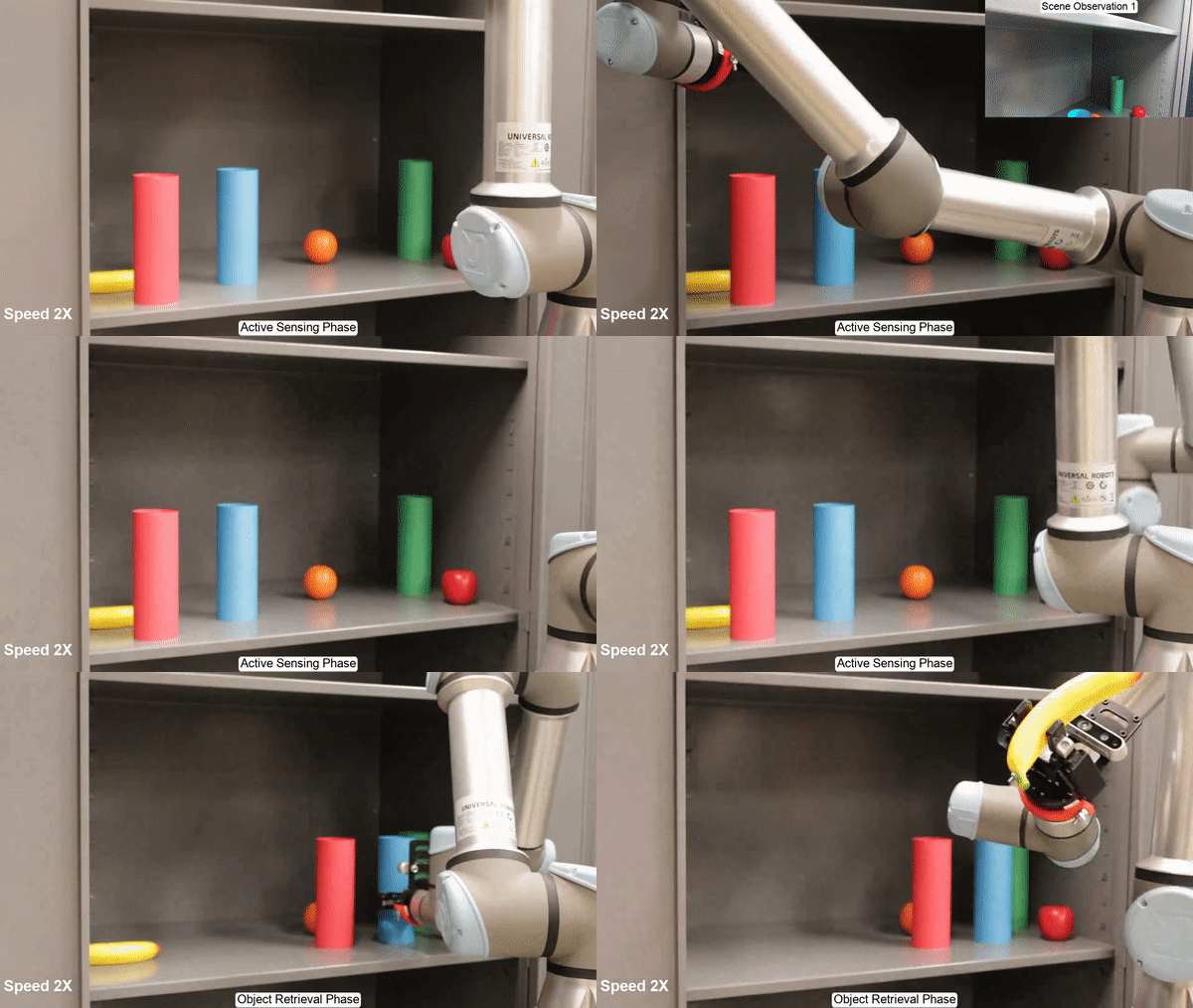
We introduce an integrated framework that smartly combines multi-stage active sensing and MCTS-based retrieval planning for object retrieval in unknown, cluttered, confined environments. Our OR-MCTS planner relocates task-blocking objects while guiding sensing toward critical unseen regions. Experiments in simulation and real robots show improved success rate and efficiency over SOTA methods.
Physics-informed Neural Time Fields for Prehensile Object Manipulation
Hanwen Ren, Ruiqi Ni, Ahmed H. Qureshi
IROS 2025
POM-NeTF is a physics-informed neural framework that enables robots to generate efficient object manipulation trajectories without expert demonstrations or trial-and-error learning. By directly solving the Eikonal equation through neural time fields, POM-NeTF learns manipulation skills that generalize across diverse objects and cluttered environments, supporting multimodal manipulation with adaptive regrasping.
Language-guided Active Sensing of Confined, Cluttered Environments via Object Rearrangement Planning
Weihan Cheng, Hanwen Ren, Ahmed H. Qureshi
ICRA 2024
We propose the first language-guided active sensing framework for confined, cluttered environments, enabling robots to perceive user-specified regions of interest through intelligent object manipulation. Our approach grounds natural language instructions in the environment, plans informative viewpoints, and iteratively rearranges view-blocking objects to achieve dense perception of otherwise occluded areas.
Multi-Stage Monte Carlo Tree Search for Non-Monotone Object Rearrangement Planning in Narrow Confined Environments
Hanwen Ren, Ahmed H. Qureshi
IROS 2024
In this work, we propose a Multi-Stage Monte Carlo Tree Search (MS-MCTS) method leveraging an intelligent subgoal-focused tree expansion algorithm to find high-quality plans for complex non-monotone object rearrangement planning problems in confined environments. Our approach results in near-optimal solutions for various object rearrangement instances of diverse difficulty levels.
Neural Rearrangement Planning for Object Retrieval from Confined Spaces Perceivable by Robot's In-hand RGB-D Sensor
Hanwen Ren, Ahmed H. Qureshi
ICRA 2024
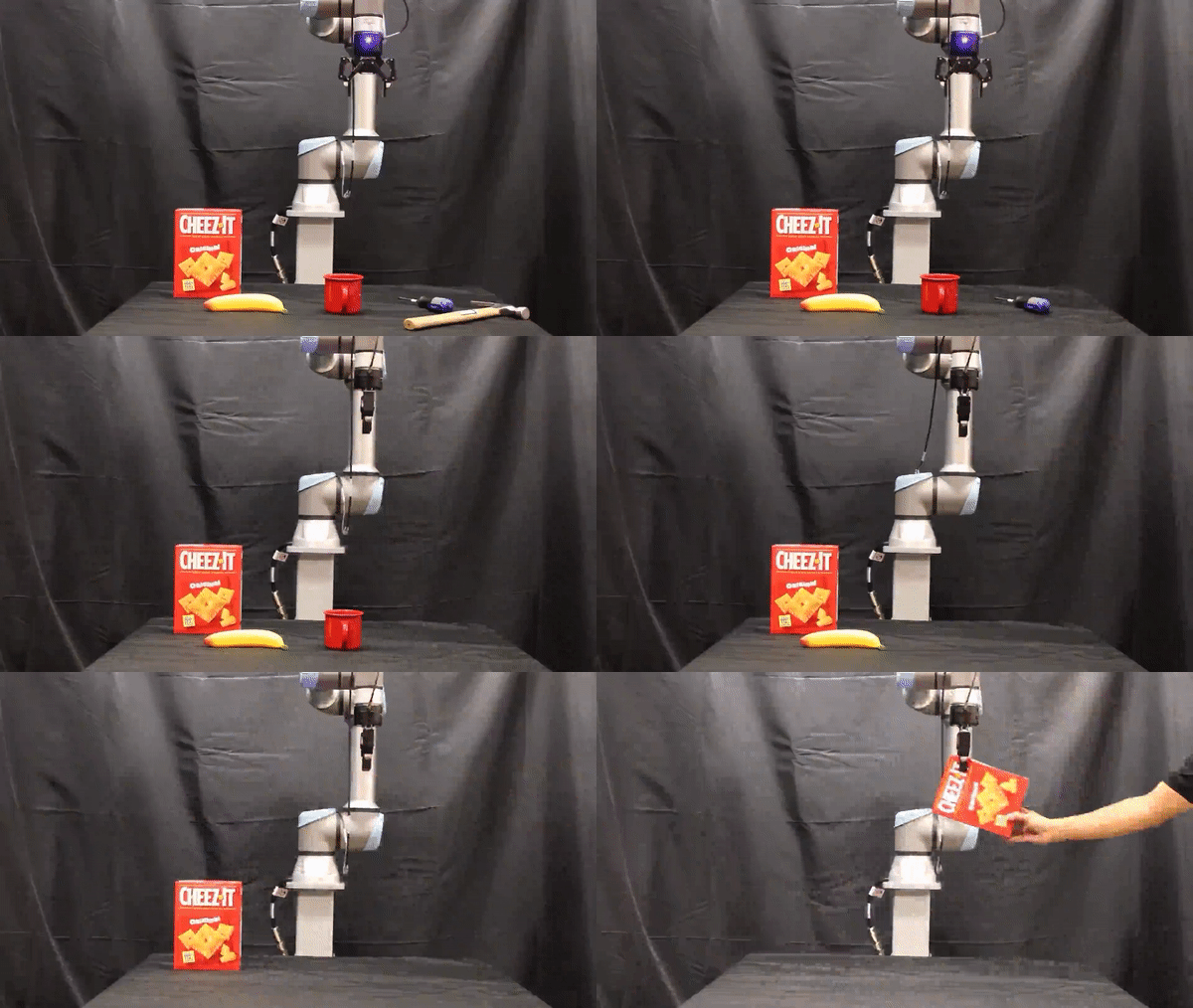
This paper presents a neural network-based object retrieval framework that efficiently performs rearrangement planning of unknown, arbitrary objects in confined spaces to retrieve the desired one. Our method demonstrates high performance by ensuring the relocation of non-target objects clear the way for the robot path homotopy to the given target object.
Robot Active Neural Sensing and Planning in Unknown Cluttered Environments
Hanwen Ren, Ahmed H. Qureshi
IEEE T-RO 2023
In this work, we present the active neural sensing approach that generates the kinematically feasible viewpoint sequences for the robot manipulator with an in-hand camera to gather the number of observations needed to reconstruct the underlying unknown cluttered environments. Our results exhibit high performance compared to traditional baselines.
Cograsp: 6-DOF Grasp Generation for Human-Robot Collaboration
Abhinav K. Keshari, Hanwen Ren, Ahmed H. Qureshi
ICRA 2023
In this paper, we propose a novel, deep neural network-based method called CoGrasp that enables robots to grasp various objects in a human-aware manner by contextualizing human preference. Our user study indicates that our approach allows safe, natural, and social-aware human-robot co-grasping experience.